Procedure Brief
MFU Platform Evolution — Five Generations, One Korean Market
How the micro-focused ultrasound device category evolved from first-generation HIFU through Ulthera, Ultherapy PRIME, Doublo, and Ultraformer — and why the device generation matters more than the marketing page suggests.
Micro-focused ultrasound (MFU) is the device category that delivers acoustic energy to a precisely targeted depth in the skin and underlying superficial musculoaponeurotic system (SMAS), heating a small focal point to a temperature that triggers controlled coagulation and the downstream collagen-remodeling response that produces the lifting result. The category is not a single device. Over the past fifteen years, MFU technology has evolved across five reasonably distinct generations, and Korean aesthetic medicine has been the global market that has absorbed and operated nearly every generation in commercial volume. The international Ultherapy patient who books a Cheongdam consult in 2026 is choosing among devices that sit at different positions on the generational arc — Ultherapy PRIME at the current Merz Aesthetics frontier, legacy Ulthera at the previous Merz generation, Doublo and Ultraformer at the Korean-manufactured high-intensity-focused-ultrasound (HIFU) parallel branch, and a handful of newer arrivals at the experimental edge. The marketing language used by clinics across these platforms is, frankly, frequently interchangeable, which leaves the international patient with a verification burden the marketing page does not honestly disclose. This page is the technical-evolution map, generation by generation, with practical implications for the 2026 booking decision. Y'all, this is the page you read after the PRIME availability map and before the consult.
First-generation HIFU — the prehistory
First-generation high-intensity focused ultrasound (HIFU) is the prehistory of the micro-focused ultrasound category that produced Ultherapy. The original therapeutic applications of focused ultrasound in medicine were in tumor ablation, where the goal was to deliver enough acoustic energy to a deep tissue target to destroy it thermally — a fundamentally different clinical objective than the aesthetic-medicine goal of triggering controlled, sub-ablative coagulation in a thin focal plane. The translation from oncology HIFU to aesthetic-medicine MFU required two technical changes: the energy delivery per shot had to be lowered substantially, and the focal point had to be tightened to a precisely-targeted depth (typically 1.5mm, 3.0mm, or 4.5mm in the aesthetic-medicine context, corresponding to the deep dermis and the SMAS layer). The first-generation aesthetic-medicine ultrasound devices that emerged from this translation in the late 2000s were rough by current standards — limited real-time imaging, broad focal points, inconsistent shot-to-shot energy delivery — but they established the basic mechanism that every subsequent generation has refined. Korean clinical practice did not engage heavily with first-generation devices; the Korean MFU adoption curve effectively began with second-generation Ulthera in roughly 2013.
- Clinical origin — therapeutic ultrasound for oncology tumor ablation
- Translation requirement — lower per-shot energy, tighter focal point
- Aesthetic depths — 1.5mm dermis, 3.0mm deep dermis, 4.5mm SMAS layer
- Early limitations — broad focal points, no real-time imaging, energy variability
- Korean adoption — minimal at first-generation, mainstream from Ulthera onward
Second-generation Ulthera — the Merz Aesthetics platform
Ulthera (technically the Ulthera DeepSEE platform from Ulthera Inc., later acquired by Merz Aesthetics) is the second-generation device that established the modern micro-focused ultrasound category and brought it into mainstream Korean clinical practice from roughly 2013 onward. The defining technical contribution of the Ulthera platform was the integration of real-time ultrasound imaging with the treatment delivery — for the first time, the treating physician could see the depth profile of the patient's skin and underlying tissue layers in real time as she planned shot placement, rather than working blind. The platform received early US FDA clearance for non-invasive lifting of the brow, submentum, and neck, and the Korean MFDS approval followed within the typical regulatory window. Korean dermatology clinics adopted Ulthera aggressively during the 2013-2018 period, and the device became the dominant ultrasound-lifting platform in the Apgujeong-Cheongdam-Sinsa dermatology cluster. The clinical limitations of the Ulthera platform — limited imaging resolution by current standards, documented shot-to-shot energy variability across the treatment field, longer pulse durations that produced a more uncomfortable in-room experience — are limitations only in retrospect, after the third-generation PRIME platform raised the bar. At the time, Ulthera was the device that defined the category, and the Korean clinical experience built up during this era is the residue that the 2026 international patient benefits from indirectly today.
Third-generation Ultherapy PRIME — the current Merz frontier
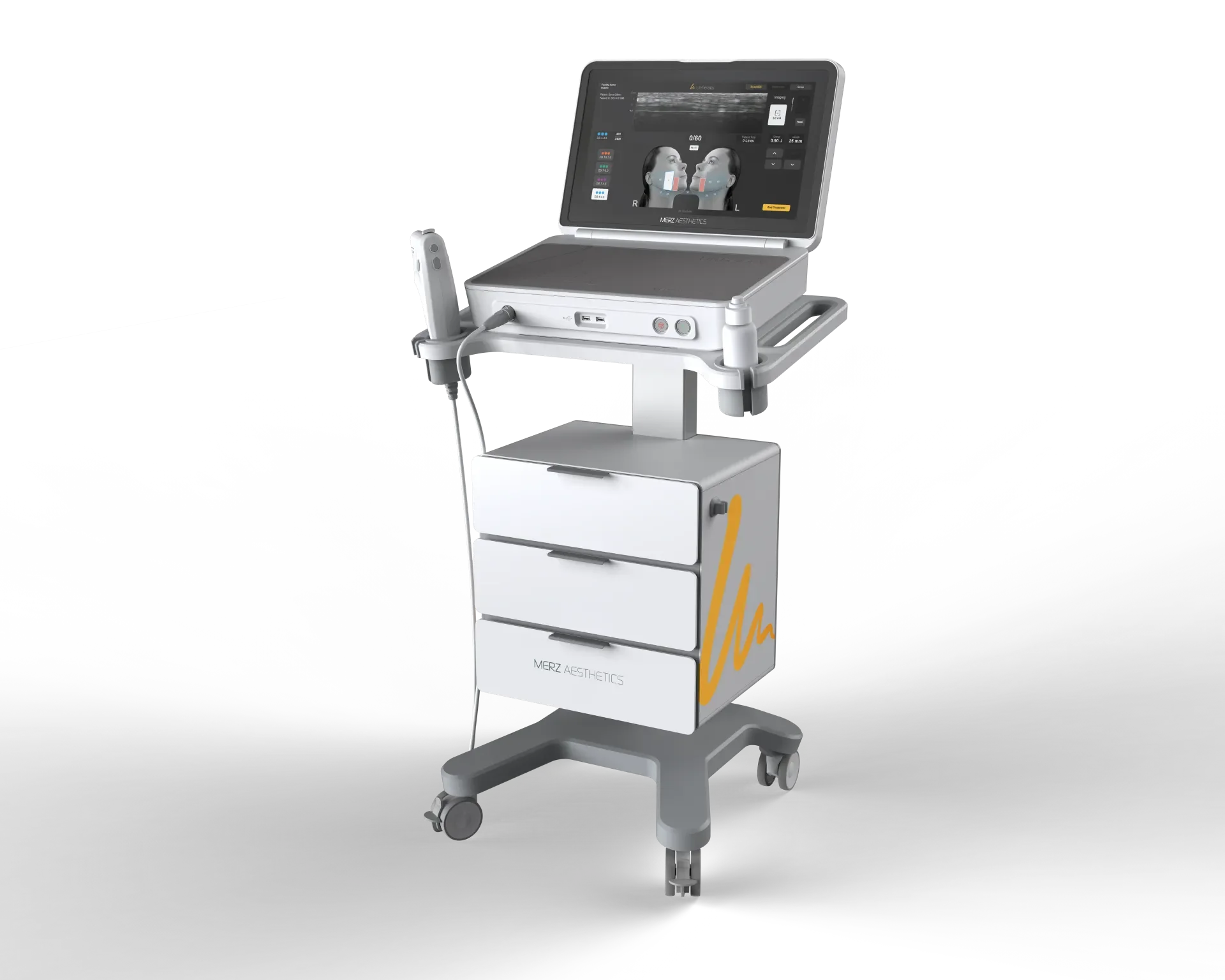
Ultherapy PRIME is the third-generation Merz Aesthetics platform that replaces the original Ulthera DeepSEE unit, rolled out internationally from 2022 with mature Korean availability reaching the major Apgujeong-Cheongdam-Sinsa clinics by roughly 2024. PRIME introduces three substantive technical advances over second-generation Ulthera. One: real-time ultrasound imaging at meaningfully higher resolution, which means the treating physician sees tissue-density variation rather than just depth markers, which is particularly useful for patients with mixed skin thickness across the cheek-jawline-neck transition. Two: more uniform shot-to-shot energy delivery across the treatment field, which reduces the bright-spot and cold-spot variability that the second-generation Ulthera unit was documented to produce. Three: shorter pulse duration per shot, which translates to a meaningfully more tolerable in-room experience for the patient — most returning patients who have done both report PRIME as 1-2 points lower on a 10-point pain scale than the comparable Ulthera session. The procedure protocol (SMAS-layer targeting at 4.5mm depth, deep-dermis targeting at 3.0mm, superficial dermis at 1.5mm, total shot count of 200-600 per full-face session depending on the protocol) is unchanged. The cost premium on Korean published price lists runs 15-25 percent over legacy Ulthera, with PRIME at the upper end. The verification burden — confirming in writing that a clinic is running PRIME versus legacy Ulthera — is the practical consequence of the generational transition, and it is documented in detail on the companion PRIME availability page.
Korean HIFU branch — Doublo, Ultraformer, Ultracel
Parallel to the Merz Aesthetics Ulthera-to-PRIME generational arc, Korea developed a domestic high-intensity-focused-ultrasound device branch that produced three platforms which have become significant categories in their own right. Doublo (manufactured by Hironic, originally launched in the early 2010s and updated through multiple generations including the Doublo Gold and Doublo S) is a multi-depth HIFU platform that targets the same anatomical layers as Ultherapy with a different transducer design and a different pulse delivery profile. Ultraformer (manufactured by Classys, with the Ultraformer III as the most widely deployed current generation) is similarly a multi-depth HIFU platform with a focus on configurable cartridge depths and a broader treatment-field-per-shot delivery pattern than Ultherapy. Ultracel (manufactured by Jeisys, with multiple generation updates) is a third platform in this branch. The Korean HIFU branch is meaningfully different from the Merz Aesthetics MFU branch in several technical particulars — broader focal points per shot, different real-time imaging implementation (or in some cases no real-time imaging), different MFDS regulatory classification — and the clinical-result profile is debated rather than settled. Korean clinics typically price Doublo, Ultraformer, and Ultracel sessions at 40-60 percent of comparable Ultherapy PRIME sessions, which makes them genuine value-tier options for the cost-conscious patient. The trade-off is the looser shot-precision standard and the variable real-time imaging support, both of which are technical realities the marketing page rarely discusses honestly.
- Doublo (Hironic) — multi-depth HIFU, multiple generation updates
- Ultraformer (Classys) — configurable cartridges, broader treatment-field-per-shot
- Ultracel (Jeisys) — third Korean HIFU branch, multiple generation updates
- Pricing — 40-60% of comparable Ultherapy PRIME on Korean price lists
- Trade-off — looser shot precision, variable real-time imaging support
MFU platform comparison at a glance
Five generations of micro-focused ultrasound, by manufacturer, technical position, and current Korean clinical role. Categorical guidance, not a clinic-by-clinic recommendation.
| Generation | Platform | Manufacturer | Korean role 2026 | Cost band relative to PRIME |
|---|---|---|---|---|
| 1st gen HIFU | Various oncology-origin | Multiple | Historical prehistory only | Not commercially deployed |
| 2nd gen MFU | Ulthera DeepSEE | Ulthera Inc / Merz Aesthetics | Legacy installations, mid-band cost | 75-85% |
| 3rd gen MFU | Ultherapy PRIME | Merz Aesthetics | Current frontier, top-band cost | 100% (reference) |
| Korean HIFU | Doublo (multi-gen) | Hironic | Value tier, broad availability | 40-60% |
| Korean HIFU | Ultraformer III | Classys | Value tier, broad availability | 40-55% |
| Korean HIFU | Ultracel (multi-gen) | Jeisys | Value tier, mid availability | 40-55% |
How to use this evolution map in your consult
The evolution map is most useful when it converts the consult-room conversation from generic 'we use ultrasound lifting' marketing language into specific 'which platform, which generation, what is the published Merz Aesthetics or manufacturer designation' technical language. The five-minute pre-trip verification protocol described on the PRIME availability page is the operational tool; the evolution map is the vocabulary that lets you read the answer. Three practical applications. One: if a clinic responds to your written verification message with 'Ultherapy PRIME, Merz Aesthetics authorized provider' — that is a clean third-generation MFU answer. Two: if a clinic responds with 'Ulthera' without the PRIME branding, that is a second-generation MFU answer, and the cost should reflect the generational gap. Three: if a clinic responds with 'Doublo' or 'Ultraformer' or 'Ultracel,' that is a Korean HIFU branch answer — a genuine and often valuable alternative, but a different technical category than the Merz Aesthetics platform, and the cost should reflect the 40-60 percent of-PRIME band. The mistake the international patient makes is treating 'ultrasound lifting' as a single category and the marketing page treating it as such; the evolution map and the written-verification protocol together close that ambiguity.
“The marketing page treats ultrasound lifting as a single category. The consult-room treats it as five generations of distinct devices with different precision standards, different imaging support, and different cost bands. The five-minute written verification before you book the flight is the difference between buying the device generation you think you are buying and buying something else.”
Sarah Mitchell, Korea MFU platform-evolution field notes
Frequently asked questions
Is Doublo or Ultraformer 'as good as' Ultherapy PRIME?
The honest answer is that the categories are different and the clinical-result comparison is debated rather than settled. Ultherapy PRIME has the most extensive clinical-trial evidence base of any ultrasound-lifting platform and the finest current real-time imaging. Doublo, Ultraformer, and Ultracel have shorter clinical-trial track records, broader focal points, and variable real-time imaging support, but they also have legitimate clinical use and produce real results at meaningfully lower cost. For a patient who values the device-precision and the imaging guidance, PRIME is the choice; for a patient who is cost-conscious and willing to accept the looser precision standard, the Korean HIFU branch is a reasonable alternative.
Why did Korea become the market that absorbed nearly every MFU generation in commercial volume?
Three structural reasons. One: the dermatology-clinic category that the 2000s laser decade produced created a ready receiving environment for non-invasive devices. Two: the MFDS regulatory pathway became one of the world's fastest for imported aesthetic-medicine devices during the 2010s, which enabled quick adoption cycles. Three: the international medical tourism policy goal codified through the KHIDI framework gave Korean clinics a structural incentive to acquire the most current device generations and operate them at international-patient pricing. The combined effect is a Korean MFU market that has more device diversity per capita than nearly any other country.
What does 'real-time imaging' actually mean in a consult?
It means the physician has a small ultrasound display showing the depth profile of the patient's skin and underlying tissue layers in real time as she plans shot placement. With the third-generation PRIME platform, the imaging shows tissue-density variation in addition to depth markers, which is particularly useful for patients with mixed skin thickness across the face. With second-generation Ulthera, the imaging showed depth markers only. With most of the Korean HIFU branch (Doublo, Ultraformer, Ultracel), the imaging is variable — some platforms include it, some do not. Asking the consult question 'what real-time imaging does your platform provide' is a useful follow-up to the device-generation question.
Does the device generation matter more than the physician's experience?
They matter together. A skilled physician on a second-generation Ulthera unit will likely produce a better result than an inexperienced physician on a third-generation PRIME unit, and a skilled physician on a Doublo will likely produce a better result than an inexperienced physician on a PRIME. The Korean Cheongdam-Apgujeong-Sinsa dermatology cluster has the deepest physician-experience density in the country, which is a different axis from the device-generation axis and should be evaluated separately. The international patient ideally wants both — current device generation operated by physicians with multi-year experience in the platform.
Are there ultrasound-lifting platforms that are not in the five generations covered here?
Yes. Sofwave (a different ultrasound mechanism that operates more superficially than Ultherapy's SMAS-layer targeting) has entered Korean clinical practice in the last few years. LDM-MED (low-frequency dual-mode ultrasound) is a different category altogether. A handful of newer platforms have emerged from Korean manufacturers and from European manufacturers that have not yet reached mature Korean availability. The five-generation framework in this page covers the dominant MFU platforms; expanding the consult question to include Sofwave or LDM-MED is reasonable if you are open to alternative ultrasound mechanisms rather than committed to the SMAS-layer targeting specifically.
How does the international patient verify which device generation a clinic is actually running?
The written verification protocol on the companion PRIME availability page is the operational tool — a WhatsApp message to the clinic's international coordinator desk that asks the device-generation question explicitly, in writing, and expects a response within 24 hours that names the platform, the generation, and the manufacturer designation. The evolution map on this page is the vocabulary that lets you read the answer accurately. The combination of the two is the high-leverage pre-trip protective step.
Will a fourth-generation MFU platform replace PRIME soon?
Not imminently. The third-generation PRIME platform is at the current Merz Aesthetics frontier and mature Korean availability has only reached the Apgujeong-Cheongdam-Sinsa cluster from roughly 2024 onward. A fourth-generation Merz platform is likely in development but has not been publicly announced for international rollout, and the typical generational cycle for major MFU platforms is seven to ten years. The PRIME generation is likely to remain the current frontier into the late 2020s at minimum.
Is the Korean HIFU branch (Doublo, Ultraformer, Ultracel) regulated differently from Ultherapy PRIME?
Yes, by both the Korean MFDS classification framework and the manufacturer-by-manufacturer clinical-trial requirements. The Korean HIFU platforms are domestically manufactured and have MFDS approval pathways that reflect that, while Ultherapy PRIME (manufactured by Merz Aesthetics) is regulated through the imported-aesthetic-medicine-device pathway. The practical implication for the patient is that the regulatory accountability for each platform sits with a different manufacturer and a different MFDS classification record. None of this is dispositive on the clinical-result question; it is just useful context for the patient who wants to understand which device sits in which regulatory category.